TracCloudWhatsNew: Difference between revisions
From Redrock Wiki
No edit summary |
No edit summary |
||
| Line 9: | Line 9: | ||
<hr style="height:1px;border:none;color:#333;background-color:#333;" /> | <hr style="height:1px;border:none;color:#333;background-color:#333;" /> | ||
{{:TracCloudWhatsNew2022-01-06_1}} | |||
<hr style="height:1px;border:none;color:#333;background-color:#333;" /> | |||
{{:TracCloudWhatsNew2021-12-27_1}} | {{:TracCloudWhatsNew2021-12-27_1}} | ||
<hr style="height:1px;border:none;color:#333;background-color:#333;" /> | <hr style="height:1px;border:none;color:#333;background-color:#333;" /> | ||
Revision as of 16:55, 12 January 2022

This page highlights some of the recent changes made to the TracCloud platform, and how you can utilize them on your own instance. A list of past changes and a full changelog can be found in the tabs above.
If you have any questions about these changes, feel free to reach out to us on our helpdesk.
Terms & Conditions allows you to create a prompt that appears for students when they're logging in, booking an appointment, or enrolling in a workshop. The prompt will contain a custom message which the student will have to agree to before continuing. While terms and conditions are the typical use-case, this feature can also be used for any purpose where a student would need to agree to a statement before having full access to the system.
Creating a New Term/Condition
Navigate to Other ➜ Listings ➜ Terms and Conditions. This listing is where you can view or edit previous T&Cs. To create a new T&C, click the hamburger icon ➜ New Terms and Conditions. If your SysAdmin account doesn't have access to these options, read the group permissions portion of this article and apply those same changes to the SysAdmin group.

This will take you to the Terms and Conditions entry screen.

- Name
- This will be the title of this T&C. This will be displayed across the top of the prompt when shown to students.
- Responses
- This will display a list of students who have accepted these T&Cs and the date of acceptance.
- Text Entry Area
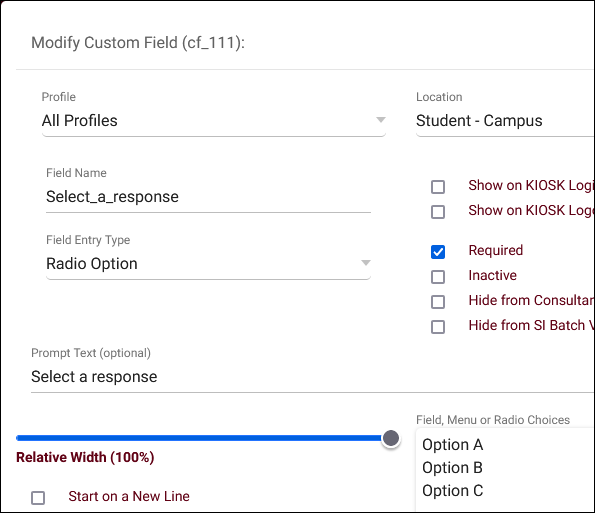
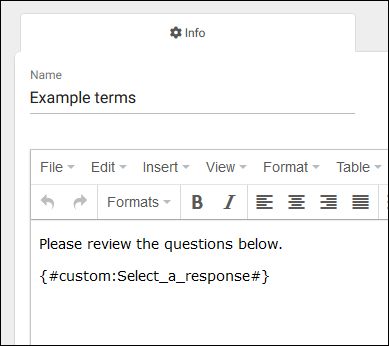
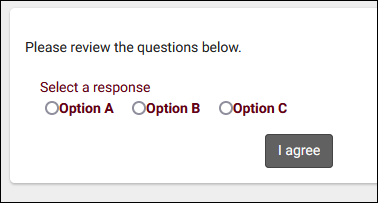
- This is where you can write out the text of this T&C that students will need to agree to before continuing. If you wish to add custom field inputs to be answered by the student, this can be entered as {#custom:field_name#}. See example screenshots below.


- Linked to Student List
- Optionally only display these T&Cs to students on the specified list.
- Linked to Section / Subject
- Terms and conditions can be assigned to a specific subject, section, or all courses, depending on if this T&C needs to be specific to a certain subject. If selected, an additional entry field will appear where you can choose the section/subject. This will only work with sections that students are registered for; non-enrolled courses will not trigger the T&C to appear.
- Profile / Center
- This is where you can assign this T&C to a specific profile or center.
- Valid For
- This option allows you to determine how long the T&C agreement is valid for. There are three options:
- Life – Never resets. Once Confirmed, the student will not see the T&C again unless this option is changed.
- Term – Resets after each semester. When next semester term switches over, the students will be asked again to agree to the T&C once again. If this T&C record appears on login and the student's registration has overridden dates, the end date of their registration will be used instead.
- Days - This option allows you set a custom length (e.g., 30 days, 90 days, etc).
- Displayed When
- This option determines where the student will see the T&C prompt.
- None - Inactive. This will deactivate this T&C. It will no longer be displayed to students.
- Student Main Menu - This will display as soon as the student logs into their account. Students will not be able to continue until the T&C prompt has been agreed to.
- Student Kiosk Login - This prompt will appear when a student attempts to login for a visit via a Kiosk, at which time they will be presented with the T&C.
- Student Booking Appointment - This prompt appears when a student selects an available time from the search availability widget on their dashboard. The T&C must be confirmed before they can book an appointment.
- Workshop Only - This prompt appears as an option when enrolling in workshops.
- Accept Button Label
- This allows you to customize the name of the confirm button (e.g., "I agree").
- Require Initials
- This requires the student to enter their initials before confirming, as a kind of e-signature.
- Allow Enter Notes
- This provides students the ability to enter in a note when filling out the T&C.
- Notes Instructions
- This is additional instructional text that will appear just above the notes field above.
Group Settings
If you need to allow another set of staff members in your TracCloud instance to access or modify Terms and Conditions, you will need to apply a change to their permission group. The Terms and Conditions option will need to be added to Table Access as seen below. This can either be set to View and Edit for full access, or View Only if you don't want these users making any changes.
Other ➜ Other Options ➜ Groups ➜ [The group you want to edit] ➜ Admin / Modules ➜ Table Access.

Example Configuration
The screenshot below shows an example of how Terms and Conditions can be configured and how it displays to students.

Here's how that prompt looks to a student when logging into their account.

After the student agrees, the record of this agreement will appear in their timeline as seen below.

Allowing Students to View Accepted Terms and Conditions
In order for students to be able to view Terms and Conditions that they've previously accepted, a system preference needs to be enabled. Go to Other ➜ Other Options ➜ Preferences ➜ System Preferences ➜ General Appointment Settings ➜ Check Allow students to view accepted Terms and Conditions on dashboard ➜ Save. Once enabled, students will see this button on their main menu next to the calendar URL. Clicking it will open a list of T&Cs they've accepted, where they can see their response and the terms themselves by clicking on the arrow button.


Student data is some of the most important in TracCloud. In addition to being the record that all their visits, appointments, documents, etc are assigned to, there's also the data stored directly in their account. You can run reports on visits grouped by student majors or send emails to students of a certain class, cohort, etc. This article goes over some of the ways you can search for these records.

The Students Listing itself (found by clicking "Students" in the navigation bar) contains all student records uploaded to TracCloud. From this page, you're able to manage student data in bulk, create lists, send emails, submit SAGE referrals, etc. You can alternatively open a specific student record and manage just that account.
Each column of information displayed has a clickable header that will sort the listing accordingly. Clicking once sorts ascending, a second click will sort descending.

Using the search bar on this screen, you can easily perform quick searches to find specific students. Right-clicking in the search bar (shown below) will provide a list of available student fields to search by. Click any of these to add that field to your query.

Example Searches:
- Find a student by a single value, such as ID. Specifying 'Students.ID=' actually isn't required for ID or Name searches, but it works well as an example.
- Students.ID=1931
- Students.ID=1931
- ...or name. Names should be formatted as 'Last, First' or 'First M Last'. 'First Last' will also work if middle names are not being imported.
- Day, Rob
- Day, Rob
- Search multiple fields at once, separate your searches by a space.
- Students.Major=Mathematics Students.Class=Sophomore
- Students.Major=Mathematics Students.Class=Sophomore
- When performing multiple searches where at least one field contains a space, make sure to surround the contents you're searching for with quotation marks.
- Students.Major="Chemical Engineering" Students.Status=Active
- Students.Major="Chemical Engineering" Students.Status=Active
- Search in Custom Fields. It's recommended to use the right-click menu to select these, as it will always auto-fill the correct field name.
- #sql:InState#=Yes
- #sql:InState#=Yes
- Date searches such as this are required to be formatted as YYYY-MM-DD
- Students.BirthDate=1993-07-16
- Students.BirthDate=1993-07-16
- TracCloud also has a special search to find students who's birthday is today.
- birthdaytoday
- birthdaytoday
- It's also possible to search for students who received a batch email from TracCloud. The search below would return all students who received a batch email from TracCloud on 2024-10-23 where the subject contained the phrase "Upcoming Event".
- MailQueue.CreatedOn="2024-10-23@" MailQueue.Category=batch_email MailQueue.Subject="@Upcoming Event@"
- MailQueue.CreatedOn="2024-10-23@" MailQueue.Category=batch_email MailQueue.Subject="@Upcoming Event@"
Students Search
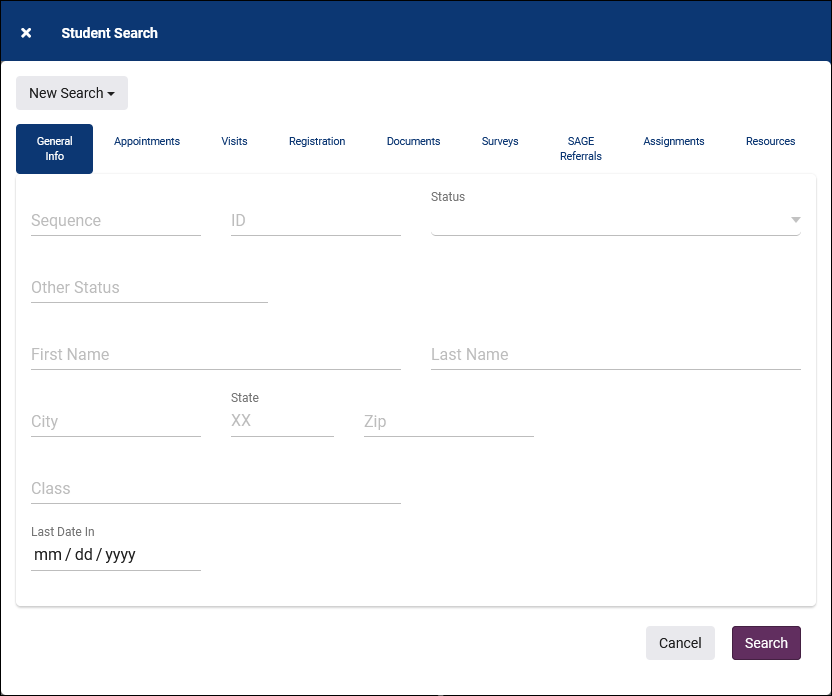
The Student Listing also has a unique Search utility found in the hamburger menu . This utility has the ability to search related tables to find relevant students. This includes the ability to run searches such as "students who have had appointments in the last 7 days" or "students who have ongoing referrals."

- Search Type
- This can be set to New Search, Search Selection, Remove found from Selection, or Add found to Selection, depending on the desired effect of this search.
- General Info tab
- This tab is where you can search for basic information about the student. ID, Status, Name, etc.
- Appointments
- This tab allows you to search for students by appointment information. For example, "students who had an appointment from 02/10 to 02/20 with a status of Missed." Any fields that support wildcards additionally support the | character for "or."
- Visits
- This tab allows you to search for students by visit info. For example, "students who visited more than 2 times from 02/10 to 02/20 where the subject was MAT100." Any fields that support wildcards additionally support the | character for "or."
- Registration
- This tab allows you to search for students by registration info. For example, "students who are actively enrolled in more than one math course." Any fields that support wildcards additionally support the | character for "or."
- Documents
- This allows you to search for students by documents. "Students who have a document of a certain filename uploaded in the last month."
- Surveys
- Students who have received or responded to a survey in a certain time period. Requires SurveyTrac.
- SAGE Referrals
- Students who have ongoing or completed referrals of a specific type in a specified date range. Requires SAGE. Any fields that support wildcards additionally support the | character for "or."
- Assignments
- This tab allows you to search by potential assignments. Any fields that support wildcards additionally support the | character for "or."
- Resources
- This tab allows you to search for students by their resource usage, whether they have certain items checked out or overdue. Any fields that support wildcards additionally support the | character for "or."
- Terms & Conditions
- Search by accepted terms and conditions. Any fields that support wildcards additionally support the | character for "or."
- Success Plans
- Search by assigned Success Plans.
Hamburger Menu
Every listing page in TracCloud features a hamburger menu with utilities to search for or interact with your list of records. Some of these options are specific to to certain listings and record types, others are shared. The following list includes definitions for the hamburger menu options available on this listing and how they can be utilized.

- List All
- This option will show all records on the current listing. Some listings have an additional toggle for only showing active records, such as the student and registration listing, which will override a List All search if checked.
- Search
- This utility will open a pop-up window unique to each Listing it's present on, allowing you to search your records by a number of different fields. In the case of the Student Listing, you could use this to search related records, such as 'Students who have at least 2 Visits in the Learning Center' or 'Students with a recent Document upload in their timeline.'

- Power Search
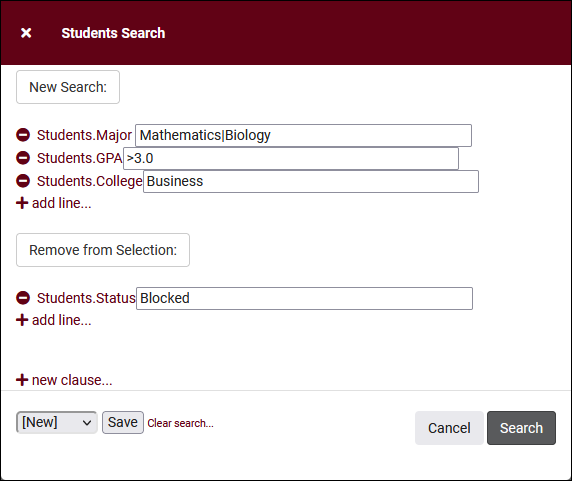
- This option provides a simple but powerful search utility to find the records you need. String together multiple searches, adding or removing results for each. Use Search Symbols to include ranges of data, and Save Searches for later use if needed. The search term 'blankornull' can be used to find all records with a value of nothing ("") or null ().

- Search by Term Enrollment
- Allows you to search based on the students' enrollment in a specific term or multiple terms. The example search below would show students who are enrolled in a 2023SP registration AND are not enrolled in a 2023FA registration.
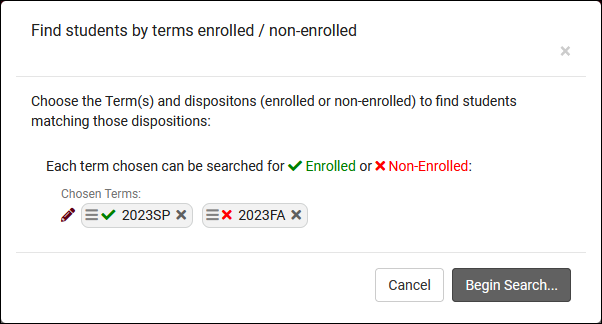
- Allows you to search based on the students' enrollment in a specific term or multiple terms. The example search below would show students who are enrolled in a 2023SP registration AND are not enrolled in a 2023FA registration.

- Lists
- See Student Lists and Watch Lists for more information.
- Saved Searches
- See Saved Searches for more information.
- Find/Merge Duplicates
- These utilities can be used to cleanup duplicate records in your Trac System. We highly recommend reaching out to Redrock Support directly for assistance in cleaning up this data.
- Find by Values
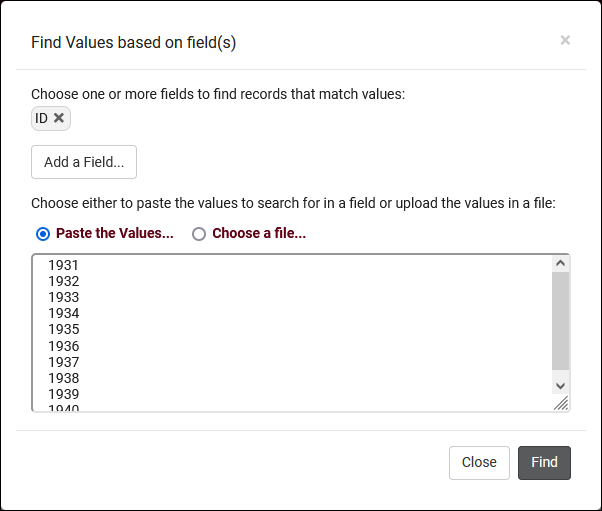
- This utility can be used to search one field for multiple values. If you have a spreadsheet containing a list of student IDs, this is an easy way to pull up the same list of students in TracCloud by copying the ID column into this search field.

- Change Field Values
- This utility allows you to make modifications in to your records in bulk. Similar to the Merge Duplicates utility, we highly recommend coordinating with Redrock Support directly on this setting.
- Selected...
- The Selection Tool offers several options to filter and manage your records. More information on this feature can be found in its own dedicated article here.
- Views
- See Views for more information.
- Send Survey
- Allows you to send a survey to the current user list. More information.
- Register In
- Allows you to quickly enroll a student in a new registration. Depending on your import configuration, manually recreated registrations may be deactivated during your auto-import.
- Assign Success Plan
- Allows you to assign a new Success Plan to the current student list. More information.
- Create Referral
- Allows you to create a batch referral through SAGE. More information.
- Create Task
- Allows you to send a task to the current student list. More information.
- Toggle Photos
- Enable or disable student photos on the Student Listing.
- Create Chart
- Based on the data currently being viewed a chart can be generated to visually illustrate the relationships in the data.
- Export CSV
- Export current listing contents to a CSV file.
- Send Email
- Allows you to send an email directly to a list of users.
- Send Email to Faculty
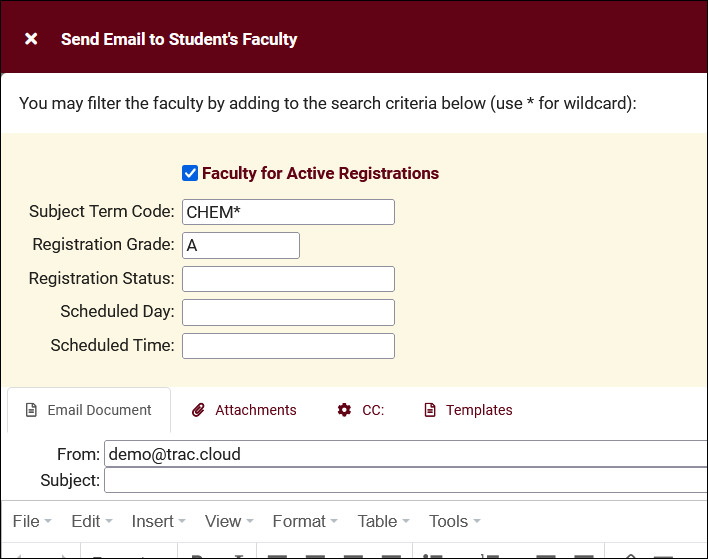
- This email utility allows you to email faculty linked to student registrations. The faculty recipients can be determined by subject, status, and grade. One email will be sent per linked registration, so if there are 3 students listed enrolled in MAT100 with Dave Smith, Dave Smith will receive 3 emails. Faculty recipients can also be filtered by scheduled day/time if section schedule is being imported.

- Show these <records>
- This utility takes your selection of records, finds the related records, and takes you to that listing with the resulting records. For example, on the Registration listing, you can "Show these Students" to display the student records for the registrations that you were viewing.
- Allows you to print the contents of the current listing, by extension this also allows you to export the current list as a PDF file.
- New <Record>
- Allows you to create a new record based on your selected listing.
See Also
Global Preferences
These preferences allow you to modify the behavior of each of the Search Availability widgets on the dashboard. For example, if you had an AdvisorTrac and a TutorTrac profile in the same instance, you may want reason to be a required search criteria for advising and only require subject for tutoring. These options allow you to offer a separate widget for each profile. More widgets can be added to your license at an additional cost. Reach out to [email protected] for more information.


- Activate primary/secondary/tertiary search availability option
- This allows you to enable additional search widgets when needed. The primary option is enabled by default.
- This allows you to enable additional search widgets when needed. The primary option is enabled by default.
- Search Availability Title
- This allows you to modify the name of the Search Availability widget on the dashboard. Also displays within the header of the subsequent search results page.
- This allows you to modify the name of the Search Availability widget on the dashboard. Also displays within the header of the subsequent search results page.
- Default Search Option
- This determines whether the Schedule an Appointment dashboard utility defaults to “First Available” or “Choose Date.” The latter will prompt staff and students to select a Profile, Center, and Date Range for their search results. Hide Search Option will hide this choice, preventing users from using anything but the default. Require Center can be enabled to require a center be selected in the "Choose Date" menu.
- This determines whether the Schedule an Appointment dashboard utility defaults to “First Available” or “Choose Date.” The latter will prompt staff and students to select a Profile, Center, and Date Range for their search results. Hide Search Option will hide this choice, preventing users from using anything but the default. Require Center can be enabled to require a center be selected in the "Choose Date" menu.
- Show Profile Option to Student
- When “Choose Date” Is used when searching for availabilities, the user is asked which Profile and Center they want to search in. This option provides the ability to disable the Profile choice for students.
- When “Choose Date” Is used when searching for availabilities, the user is asked which Profile and Center they want to search in. This option provides the ability to disable the Profile choice for students.
- Show Search Center on Widget
- If enabled, a center choice will be shown above the subject/reason menus on the search availability widget. The Require Center option also applies to this if you want to require users select a center to search for availabilities.
- If enabled, a center choice will be shown above the subject/reason menus on the search availability widget. The Require Center option also applies to this if you want to require users select a center to search for availabilities.
- Show Search Consultant on Widget
- If enabled, a consultant choice will be shown below the subject/reason menus on the search widget. Show Search Center on Widget must be enabled first.
- If enabled, a consultant choice will be shown below the subject/reason menus on the search widget. Show Search Center on Widget must be enabled first.
- Show Search Location on Widget
- If enabled, a location choice will be shown above the subject/reason menus on the search widget. Show Search Center on Widget must be enabled first.
- If enabled, a location choice will be shown above the subject/reason menus on the search widget. Show Search Center on Widget must be enabled first.
- Allow Search Subject/Reasons
- Allows you to disable the Subject or Reason search options within the Schedule an Appointment utility.
- Allows you to disable the Subject or Reason search options within the Schedule an Appointment utility.
- Search Subject/Reason Prompt
- Allows you to modify the phrasing of these drop-down fields in the Search Availability box on the dashboard. Search Conjunction determines whether the two fields are separated by an And or an Or.
- Allows you to modify the phrasing of these drop-down fields in the Search Availability box on the dashboard. Search Conjunction determines whether the two fields are separated by an And or an Or.
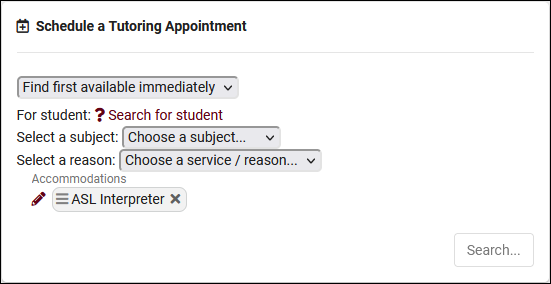
- Allow Special Skills
- If enabled, students/staff will see the skills and accommodations search field when searching for availabilities. This should be enabled if using this functionality.

- Linked Special Skills
- This allows you to restrict which skills/accommodations are available in this widget. Default is blank (all).
- This allows you to restrict which skills/accommodations are available in this widget. Default is blank (all).
- Allow user to adjust chosen special skills
- If checked, users can specify which skills/accommodations they want to search for. If unchecked, all available special skills will be chosen (as determined by Linked Special Skills).
- If checked, users can specify which skills/accommodations they want to search for. If unchecked, all available special skills will be chosen (as determined by Linked Special Skills).
- Load Skills from Student / Other
- Automatically select student skills/accommodations based on Linked special needs to student lists. Alternatively, the skills and accommodations can be loaded based on a recent SAGE referral for this student. If based on referral, you will need to select the related referral type in Load Special Skills from which Referral below.
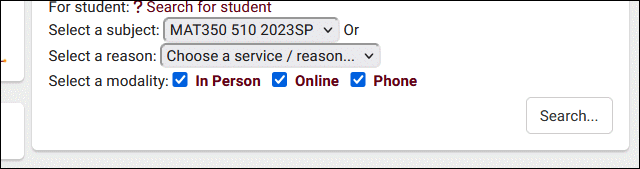
- Allow user to choose modality
- If any combination of modalities are chosen on this screen, a new option will appear in the search availability widget to allow users to filter by appointment modality prior to seeing results. The title of this field can be customized by modifying "Modality Prompt."

- Auto Choose Modality
- If a modality is chosen in this field, only availabilities matching that modality will appear in search results. For example, you may have an in-person search availability widget and a separate online search availability widget. Unless this kind of configuration is needed, it's recommended to leave this field blank (i.e., all modalities).
- If a modality is chosen in this field, only availabilities matching that modality will appear in search results. For example, you may have an in-person search availability widget and a separate online search availability widget. Unless this kind of configuration is needed, it's recommended to leave this field blank (i.e., all modalities).
- Search Availability Instructions
- A custom message that displays during the Search Availability process for staff/students. This field supports HTML.
- A custom message that displays during the Search Availability process for staff/students. This field supports HTML.
- Hide Dropins from Students
- If enabled, Drop-in-type availabilities will not appear in availability search results for students.
- If enabled, Drop-in-type availabilities will not appear in availability search results for students.
- Do not stack similar results
- By default, TracCloud will stack similar availabilities in search results. This requires that the availabilities have the same meeting type, start time, end time, and center. Clicking on the stack expands the availabilities, where students can choose the consultant they want to work with. Enabling this option disables this functionality, so that availabilities are never stacked.
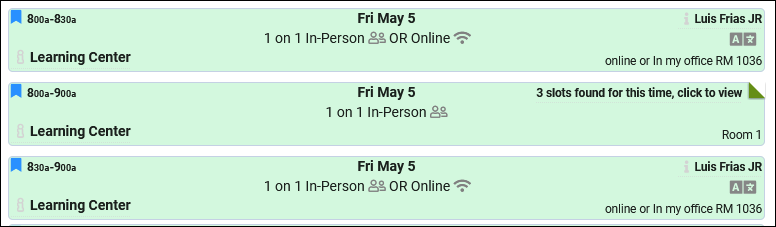
- By default, TracCloud will stack similar availabilities in search results. This requires that the availabilities have the same meeting type, start time, end time, and center. Clicking on the stack expands the availabilities, where students can choose the consultant they want to work with. Enabling this option disables this functionality, so that availabilities are never stacked.

- Randomize similar results
- If enabled, consultants with identical availabilities (like above) will be randomly ordered rather than being ordered alphabetically by name.
- If enabled, consultants with identical availabilities (like above) will be randomly ordered rather than being ordered alphabetically by name.
- Linked Profiles & Linked Centers
- This option allows you to only show availabilities from a particular profile or center (or multiple profiles/centers). The default for both is blank, meaning availabilities from all profiles/centers will be shown. Center choice does not override profile choice, if you select Profile 1 and a center from Profile 2, the Profile 2 center will not appear in search results. Profile 2 must also be linked to the widget, or the linked profiles field can be left blank.
- This option allows you to only show availabilities from a particular profile or center (or multiple profiles/centers). The default for both is blank, meaning availabilities from all profiles/centers will be shown. Center choice does not override profile choice, if you select Profile 1 and a center from Profile 2, the Profile 2 center will not appear in search results. Profile 2 must also be linked to the widget, or the linked profiles field can be left blank.
- For Students on List
- This allows you to only display this search widget to this List of Students. Leave blank to disable.
- This allows you to only display this search widget to this List of Students. Leave blank to disable.
- Appointment Invitation Preferences
Additional settings can be found beneath these settings. These apply to all search availability widgets.

- Additional Instructions
- Optional text that appears for those using the 'Choose a Date & Center' option for availability search. "Appointments must be scheduled at least 12 hours in advance" in the example screenshot below.
- Optional text that appears for those using the 'Choose a Date & Center' option for availability search. "Appointments must be scheduled at least 12 hours in advance" in the example screenshot below.
- Prompt for choosing which profile/center of services and Title for All Profiles/Centers option
- Change the phrasing of these choices within the 'Choose a Date & Center' option.
- Change the phrasing of these choices within the 'Choose a Date & Center' option.
- Default search availability date choice
- Sets the default date choice within the 'Choose a Date & Center' option.
- Sets the default date choice within the 'Choose a Date & Center' option.

- Unbooked availabilities become dropins to students on search availability
- If checked, in the event that an in-person availability block is not booked within the allowed limit of your profile scheduling restrictions, the availability block will continue to be shown to students as an in-person drop-in to allow the time slot to still be utilized. You can make exceptions to this rule via permission groups under the "Scheduling" tab.
- If checked, in the event that an in-person availability block is not booked within the allowed limit of your profile scheduling restrictions, the availability block will continue to be shown to students as an in-person drop-in to allow the time slot to still be utilized. You can make exceptions to this rule via permission groups under the "Scheduling" tab.
- As an example, this system doesn't allow students to book appointments within an hour of the session starting. At more than an hour out, it appears normally.

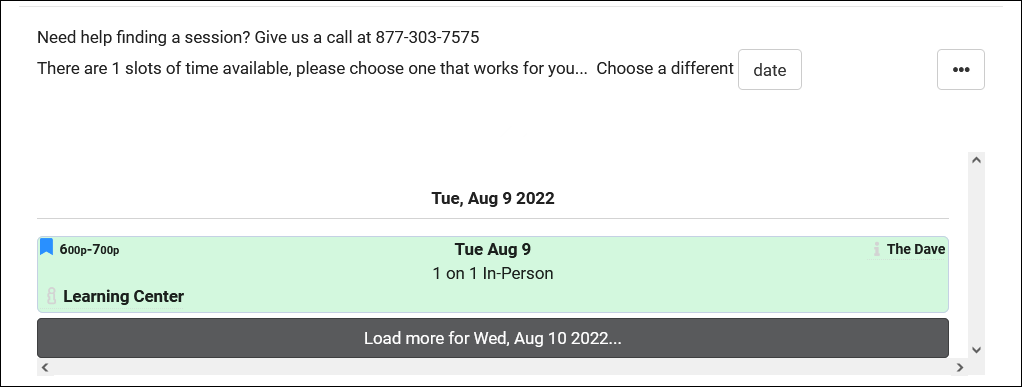
- As an example, this system doesn't allow students to book appointments within an hour of the session starting. At more than an hour out, it appears normally.


- However, once we pass our 1-hour example threshold, the availability on the staff schedule looks normal, but students will now see this time as an available in-person drop-in session.

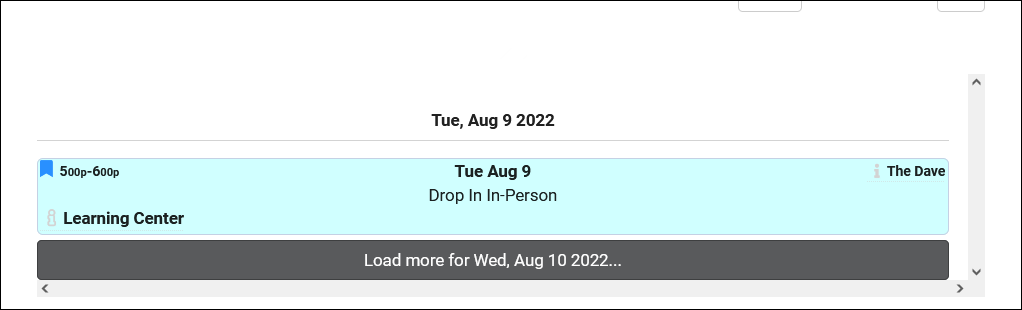
- However, once we pass our 1-hour example threshold, the availability on the staff schedule looks normal, but students will now see this time as an available in-person drop-in session.


- Hide number of slots found when the campus rules 'too soon' message is displayed
- When searching for availabilities beyond what your "Schedule no sooner than" preference allows, TracCloud will inform the user/student that there are X number of availabilities on that date, and to come back later. If you'd prefer that TracCloud did not give a total number, this preference can be enabled.
- When searching for availabilities beyond what your "Schedule no sooner than" preference allows, TracCloud will inform the user/student that there are X number of availabilities on that date, and to come back later. If you'd prefer that TracCloud did not give a total number, this preference can be enabled.
- Additional style formatting for Time, Consultant Name, & Location
- Add style additional styling information to these fields as they appear on the search availability results page. This is commonly used to make text larger, with a value such as "font-size: 15px;" but other style attributes can be applied.

- Master List for Search Availabilities Subject
- Allows you to restrict Search Availability to a specific list of sections, overriding the Center and Consultant course lists.
- Allows you to restrict Search Availability to a specific list of sections, overriding the Center and Consultant course lists.
- Name for...
- These options allow you to change the phrasing of availabilities types in TracCloud. For example, if your students find 'Multi-person' more clear than 'Group', it can be changed here. Default phrasing will be used if these are left blank.
- These options allow you to change the phrasing of availabilities types in TracCloud. For example, if your students find 'Multi-person' more clear than 'Group', it can be changed here. Default phrasing will be used if these are left blank.
- Format to display Search Subject
- Allows you to modify the format of subjects within the Search Availability widget. E.g., including or excluding Title, Section, Faculty, etc.
- Allows you to modify the format of subjects within the Search Availability widget. E.g., including or excluding Title, Section, Faculty, etc.
- Allow Course Lists to be assigned to availabilities
- Allows you to choose a course list in the availability subject field as a form of section group. If a course list is selected on a drop-in availability and the student joins with the ad-hoc QR code, the closest matching section from their registrations will be automatically chosen, similar to SI Batch Visits.
- Allows you to choose a course list in the availability subject field as a form of section group. If a course list is selected on a drop-in availability and the student joins with the ad-hoc QR code, the closest matching section from their registrations will be automatically chosen, similar to SI Batch Visits.
- Allow move appointment to earlier time
- This allows you to move appointments to a past availability slot with the "Move" button in appointment records, and how many hours in the past are allowed. The recommended value for this option is 0.
- This allows you to move appointments to a past availability slot with the "Move" button in appointment records, and how many hours in the past are allowed. The recommended value for this option is 0.
- Relax Availability Reasons restrictions for Specialties (use Center Reasons only)
- By default when creating availabilities and appointments from the staff schedule, the consultant's reason specialties are used to filter the list of available reason choices. Checking this box bypasses that filter, showing all reasons for the center regardless of the consultant's specialties. This does not apply to the search availability dashboard widget(s), where reason specialties will still apply.
- By default when creating availabilities and appointments from the staff schedule, the consultant's reason specialties are used to filter the list of available reason choices. Checking this box bypasses that filter, showing all reasons for the center regardless of the consultant's specialties. This does not apply to the search availability dashboard widget(s), where reason specialties will still apply.
- Allow availabilities to utilize Phone as a modality
- Enables "Phone" as a meeting type/modality in addition to in-person, online, and asynchronous in availabilities and appointments.
- Enables "Phone" as a meeting type/modality in addition to in-person, online, and asynchronous in availabilities and appointments.
- Automatically block student class schedule during search availabilities
- If you import section schedule data into TracCloud, this option can be used to prevent students from booking appointments that conflict with their class times.
More information on this feature can be found in its own dedicated article here.

- Setting for Report Unable to Find Appointment
- This adds a utility to the Search for Availability screen allowing staff and students to report that they weren’t able to find an availability that works for them. Button Label can be used to change the student-facing phrasing of this option.
- Off disables this functionality.
- Standard provides a standard form where students can write out what they searched for and what they did (or didn’t) find. These reports can later be reviewed and managed by staff with the appropriate permissions.
- Custom Link lets you enter a custom URL that students will be taken to after selecting the “Report Unable to Find an Appointment” button.
- Allow Staff Only disables the "Report unable to find appointment" button in the search availability process, but the Outstanding Appointment Requests listing remains available, which staff can manually create requests from.
- Button Label
- Changes the label of the button that students would click when using this utility. Report Unable to Find Appointment by default.
- Instructions
- This text appears within the "Unable to Find Appointment" prompt for students & staff, and can be used for additional instructions or contact methods.
- Question: What were you hoping to find and What did you find instead
- These fields allow you to override the question text for these default fields.
- Student info Tags
- Enter additional text and student Twig tags to be displayed in the appointment request record, visible only to staff with access to these requests.